While we tend to know the streets nearest our homes best—where to stop, lights to avoid, speed bumps ahead—we aren’t as confident elsewhere. As we drive further from our neighborhood, we rely on street signs to keep us safe. But when these signs are in a poor, unreadable condition or missing altogether, they can expose us to accidents and injuries. What’s worse, it could lead to fingers pointing at us when the fault potentially lies elsewhere.
When a hidden stop sign or generally bad signage is the potential cause of an accident, it seems deeply unfair to blame the driver who couldn’t see it. At Montlick, that kind of unfairness is what our car accident attorneys fight against every day. So if you’ve fallen victim to bad signage on the roads, call us for help holding the governmental authorities responsible for the sign accountable. You can sue a government authority for these accidents, but the complexities involved are worth exploring below.
How Bad Signage Causes Accidents
It’s unclear just how many accidents in Georgia are due to bad signage, but there’s national data that helps fill in some of the gaps. A 2008 report to Congress attributed 10,631 crashes to a traffic sign or signal being missing. More recent data point to close to 600 deaths each year in wrong way accidents that may have an origin in obstructed or missing signs.
Deteriorated Signs
Exposure to the elements day after day, vandalism, and general wear and tear can reduce street signs’ useful lifespan. When deteriorated signs aren’t repaired or replaced regularly, this can create confusion on the roads that can lead to accidents. It isn’t hard to imagine the chaos that could ensue if half of a speed limit sign was missing—there’s quite a difference between 35 and 65 mph, though the roads might look the same.
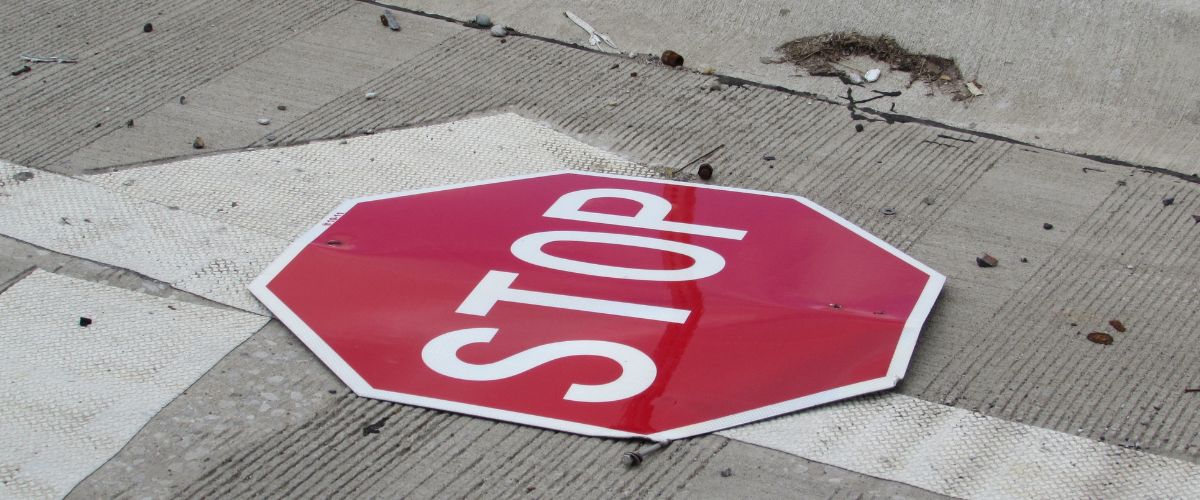
There may also be situations where a previous driver has knocked over a street sign, making it difficult if not impossible for other drivers to read it. Without repairs or a new sign put in its place, drivers won’t be warned of hazards or be aware of possible dangerous road conditions.
An Obstructed Roadway Sign
Some accidents may result from a road sign that’s partially or completely obstructed from view. Often, vegetation overgrowth blocks drivers from seeing and responding to the sign. This threat is pronounced in states like Georgia, where vines like kudzu can devour a street sign in weeks. When vegetation isn’t cleared from these signs it can lead to accidents.
A National Highway Traffic Safety Administration report to Congress gave one example of this type of accident, where the driver of a Ford Mustang collided with a Honda Pilot at a four-way intersection because the stop sign was obscured by branches.
Missing Signage
Street signs can go missing for numerous reasons, including theft. In some cases thieves steal the signs to sell them as scrap metal, while other times the sign might only serve as interesting decoration. In Jefferson County, Georgia, municipal administrators estimated they were losing roughly 12 signs every week. When signs naming streets go missing, this can create confused and overly cautious drivers. But when stop, yield, or wrong ways signs are stolen, these can create collisions that impact the lives of innocent victims.
Poorly Located Signage
Where a sign is placed in relation to the information its conveying plays an important role in its usefulness. We wouldn’t find a stop sign placed 20 feet in front of the intersection all that helpful, for example. While that’s an exaggerated example, what does occur are signs placed where they don’t provide enough warning to drivers. A sign that doesn’t give a driver enough time to react to a lane merge, incoming traffic, or an exit can force drivers into last-minute maneuvers that may lead to accidents.
Who’s Responsible for Bad Signage
In many of the above situations, a government agency is responsible for problems related to the signs. Government agencies have a duty of care to drivers to ensure the roads are reasonably safe. Road signs help create the standards for other drivers and are therefore essential to creating safe streets. When signs fail, including for the reasons mentioned above, these agencies may have failed to perform their duty of care.
- Failing to provide required signage: A government agency may fail to provide the signs necessary to keep people safe. An agency may choose not to put a sign at a location in an effort to save money or because they fail to consider how drivers will respond to road conditions. These decisions may prove costly in the long run when they cause accidents.
- Failing to repair or replace signs: If someone has knocked over a sign, or vandals have spray painted over an important message, this can leave drivers unaware of what hazards their driving into. If agencies don’t replace the sign or repair it, they may be responsible for the accidents that result.
- Inappropriate placement or angle: When engineers and road planners decide where to place signs, they may be working off wrong assumptions or lack crucial information. If a street sign has been placed at the wrong spot, causing accidents, and the agencies responsible don’t choose to move the sign in response, that could be negligence.
- Ignoring Complaints: Everyday citizens relay important information to government agencies, especially when they’re complaining about unreadable, damaged, or obstructed roadway signs. If these complaints are received but go unheeded and unaddressed, it could expose the agency to liability when accidents occur.
What Makes Claims Against Governments Complex?
If you’ve experienced an accident caused by bad signage, you may have wondered, “Can you sue a city for bad roads and signs?” The answer is probably yes, but it isn’t so straightforward. Filing claims against government agencies are subject to a host of different laws and procedures that can keep innocent victims from the compensation they’re owed. If you do need to pursue a claim against a government agency, you want to have legal representation with experience handling these kinds of claims to prevent denials on technicalities or other roadblocks.
One of the biggest hurdles to overcome when suing a state, county, or municipal agencies is sovereign immunity. This doctrine predates the United States and holds that the federal government and states cannot be sued unless they give their consent. If the state does not give its consent, it is immune from liability. While developments over the years have chipped away at sovereign immunity, it remains a powerful force in Georgia courts.
Georgia Waives Immunity In Specific Circumstances
Georgia, like many states, does waive sovereign immunity in certain instances, including in some personal injury contexts. According to GA Code § 50-21-23, sovereign immunity does not apply to torts committed by state officers and employees while they act or fail to act within the scope of their official duties or employment. While a state employee may be the one who failed to perform their duties, the law requires that the state agency be the only one named in the suit.
As it relates to bad signage and road care, GA Code § 50-21-24(10) states that Georgia agencies are not liable for the plan or design related to the construction or improvement to highways, roads, streets, bridges or other public works. However, this immunity only applies as long as the plan was prepared in “substantial compliance with generally accepted engineering or design standards.” If the plan was out of alignment with the standards that existed when the construction or improvement was carried out, then the state could be liable.
Another restriction on Georgia’s liability relates to the discretion that state employees use. There’s a tension between wanting our government officials to feel free to make decisions as needed, and wanting them to avoid taking improper action. In Georgia, GA Code § 50-21-24(2) shields state employees from liability when they’re exercising their discretionary functions, that is, when they exercise their judgment and choose between alternate courses of action. In a case related to bad signage, the question becomes whether the state employee’s actions were discretionary or instead a ministerial duty, requiring following a set rule or specific directive.
Finally, different procedures apply when suing the state than when suing private entities. According to GA Code § 50-21-26, injured victims generally have 12 months from when the accident occurred or when they should have discovered their losses (like injuries) to notify the state of Georgia. The injured plaintiff must notify the relevant agency and the Department of Administrative Services, who have 90 days to approve the claim or deny it. If they take no action within 90 days, the victim can then sue. While technically an injured victim has two years from the date the loss was or should have been discovered, the 12-month requirement for notice means the deadline to place the government on notice of a claim (also known as an “Ante Litem Notice”) is usually shorter than two years.
Georgia Counties Have Broad Immunity
Counties have control over county roads and other streets, roads, and bridges that cut through their jurisdiction where there’s no municipality. Georgia has the second-most counties in the United States and they enjoy broad immunity from claims. According to GA Code § 36-1-4, a Georgia county can only be sued if a statute specifically enables it. Additionally, GA Code § 36-11-1 states that notice of a claim against counties must be made within 12 months of the accident or the claims are forever barred, with limited exceptions.
Cases like these require an experienced auto accident attorney because there are such limited circumstances under which an injured victim can sue. A Georgia attorney with experience pursuing justice against county conduct will be familiar with the relevant state statutes that enable a victim to potentially receive compensation from a county.
Can You Sue A City for Bad Roads & Signs?
Georgia’s General Assembly has also extended sovereign immunity to municipalities within the state, complicating matters for innocent victims. Similar to the state, GA Code § 36-33-2 states that municipal employees cannot be held liable for their discretionary acts. However, there is liability when municipal employees neglect to perform or improperly perform their ministerial duties under GA Code § 36-33-1. A veteran car accident lawyer would argue bad signage implicates a ministerial rather than the discretionary functions of a municipal authority.
On the procedural side, GA Code § 36-33-5 requires that injured victims seeking compensation give notice to the city within 6 months. This notice must state the time, place, and extent of the victim’s injuries and be presented to the municipal authority in charge of adjusting, or settling, these claims. The municipality has 30 days from the date they receive that notice to settle the claim. If they choose not to settle or if they don’t offer a satisfactory settlement, a lawsuit can be filed.
How Our Attorneys Build a Case For Compensation Due to Bad Signage
Formally speaking, one of the first steps in recovering compensation for victims injured due to poor road signage and design is the notice to the appropriate government agency. However, the work of an accident attorney will begin possibly long before this step is taken. The clearer and more persuasive the initial notice is, the greater likelihood the governing authority will offer a fair settlement. To make that notice as strong as possible, an attorney will attempt to make that notice as close to trial ready as possible. Here’s how our experienced attorneys do just that.
Collect Direct Evidence from the Site
The paramount concern after an accident is health. Getting medical treatment for injuries as soon as possible should be your first step. There is, however, another pressing concern—evidence. As you recover from your injuries, trying to collect evidence from the accident may be painful for multiple reasons. However, this evidence can fade fast, which is why bringing in trusted representation early can make all the difference.
Our attorneys can go to the accident scene in an effort to collect as much evidence of the accident as possible. In a case of bad signage, this includes the sign itself, its surroundings, and visibility from the road. They’ll also look to document the condition of the road and check to recover evidence of skid marks and the like.
Contact Eyewitnesses
Another crucial source of evidence related to the accident is the testimony of eyewitnesses. If there were other passengers in the car, they may be able to verify that all attempts were made to locate a street sign, or that one was not visible from the vehicle. Eyewitnesses from outside the vehicles in question may be able to substantiate that there was a knocked over street sign that caused the accident.
Documenting Related Accidents
Central to suit related to a defective or obstructed roadway sign are other similar accidents. These may be accidents related to the same sign or to similar conditions to the one in question. Our experienced attorneys pore through past court records, police reports, and other sources to find this information that may establish that there are dangers known to government authorities that they failed to mitigate. For example, past Georgia Highway Safety Reports acknowledge that rural roads in Southeast and Northeast Georgia are, “unimproved with soft shoulders and inadequate signage and striping.” This information helps make clear that relevant agencies knew the signs posed a risk but failed to act.
Subpoenaing Maintenance Related Records
In a similar vein, our attorneys may turn to subpoenaing maintenance records to get the information they need to build a comprehensive case. The information these records contain help show whether the signs were being maintained adequately. Long stretches of no maintenance can show that the government agency failed to create reasonably safe conditions on the road.
When Poor Road Conditions Cause Accidents, Contact Montlick
Accidents caused by bad signage or obstructed roadway signs shouldn’t be blamed on drivers who tried to do the right thing. Don’t settle for less or be intimidated into accepting blame. Contact Montlick for a free consultation regarding your claim.